

Few teams have endured a whirlwind of chaos quite like the Caledonia Gladiators this season. A disappointing 3-5 record in the Trophy Group stages, followed by an 0-2 start to the Championship, led to a club statement that head coach Gareth Murray would “move on” from his current role. Then the floodgates of instability opened.
Two days later, Nick Tomsick was signed and Ian Dubose was released. Two weeks later, interim head coach Lluis Reira led the team to their first Championship win over London. Two days after that, Robbie Peers was named head coach, and Lluis Reira left for Spain. At the end of that week, Jared Wilson-Frame, Malik Dunbar, and Elijah Cain joined the roster, with Isaiah Hill departing. The 22-day Nick Tomsick era also came to a close. Tanner Stuckman left at the end of the following week, and Teddy Okereafor signed.
This constant churn in leadership and personnel has left Caledonia searching for stability and identity. As they look to 2025, the team faces the challenge of balancing a fresh philosophy under Peers with the need to build chemistry on the court.
Starting Lineups in Flux
The numbers illustrate Caledonia’s instability. Through 19 games this season, they have fielded 15 unique starting lineups—the highest rate in the league. This contrasts sharply with teams like the Leicester Riders, who have only used 2 lineups in 17 games.

A Revolving Door of Players
Roster instability extends beyond starting lineups. The chart below shows the extent of turnover this season. Players with faded bars have already left the team, while those with navy bars have joined mid-season.
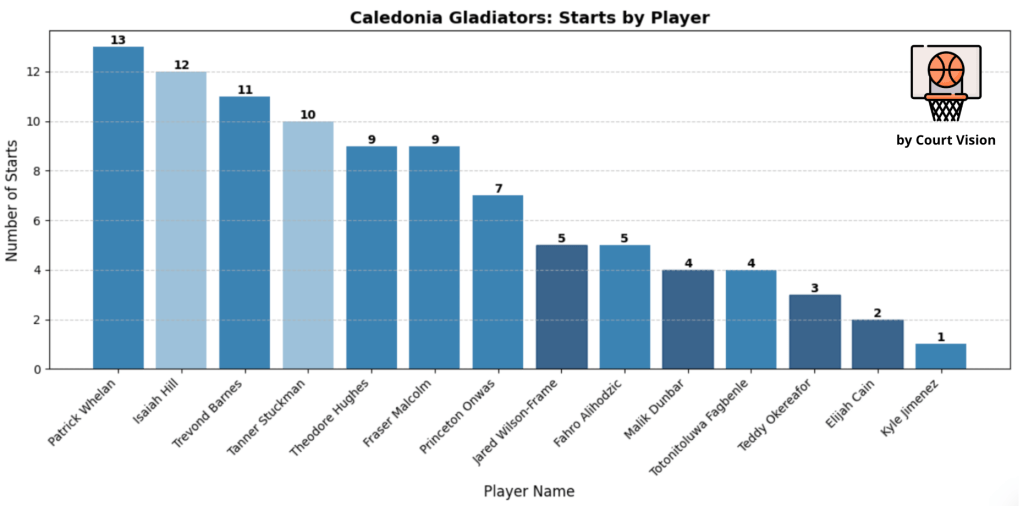
Key departures like Isaiah Hill (12 starts) and Tanner Stuckman (10 starts) left significant gaps in the roster. Meanwhile, Jared Wilson-Frame, Malik Dunbar, and Elijah Cain are part of the new wave of players brought in to stabilise the roster and inject fresh energy.
Jared Wilson-Frame especially has shown flashes of brilliance, offering hope that these mid-season adjustments can lead to greater stability. However, even players with consistent starting roles, like Patrick Whelan, have had to adapt to the ever-changing lineups around them, underscoring the broader challenges of achieving cohesion.
Reimagining Rotations Under Peers
One of the most noticeable changes under Robbie Peers has been the shift in the length of Caledonia’s rotations. Peers was known for his extremely short rotations during his heyday in the early 2000s, often relying on just six players to carry the load.
At the start of this season, Caledonia leaned toward longer rotations, with many players contributing regularly. However, the chart below illustrates how this philosophy has changed since Peers took the reins:

Injuries have undoubtedly influenced Caledonia’s recent rotations, but Peers’ preference for shorter lineups was still evident beforehand. This approach, rooted in his trust in a core group of players, can help foster cohesion among key contributors. However, the demands of today’s fast-paced, spaced-out game may expose the limitations of this strategy. To thrive in 2025, Caledonia will need to find a balance between leaning on their core players and building depth to sustain success over the long season.
Hope for the New Year
Robbie Peers, a coach who dominated British basketball 20 years ago, has the chance to instil a new identity for the team. Yet questions remain about whether Peers can adapt to the modern game and bring the winning mentality Caledonia so desperately needs.
Their recent cup victory over Newcastle offered a glimpse of the team’s potential, showcasing talent that could drive success in 2025. While the road ahead is far from easy, if Peers can stabilise the roster, adapt his tactics, and establish consistency in rotations, Caledonia may finally find the identity they’ve been searching for.
Links
- Sunday Night Breakdown discussion of Robbie Peers https://youtu.be/IbjBezmDRDQ?t=4677&si=X95uYWZ4wiwBFUw5
