
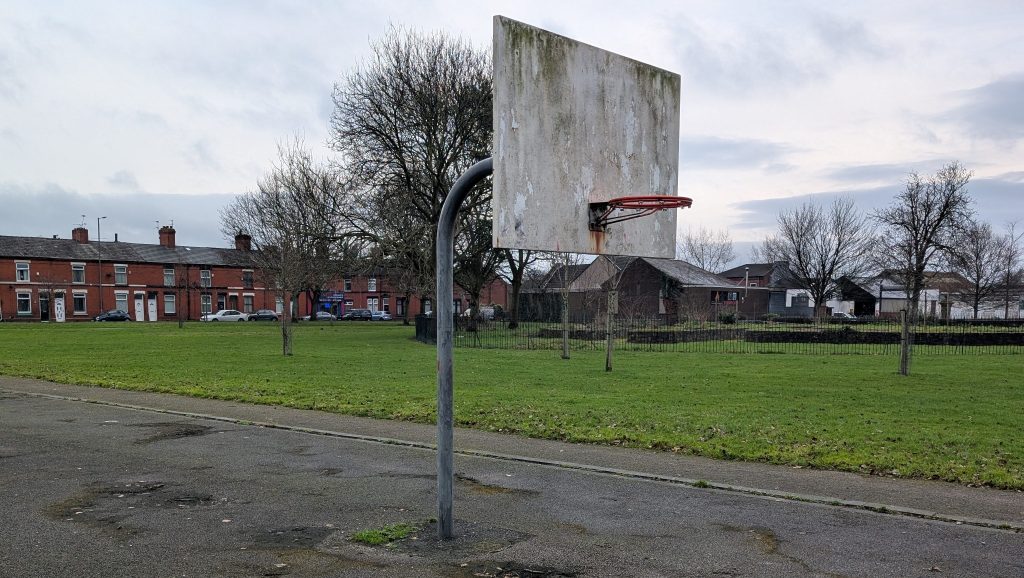
British basketball has no problem getting kids onto the court. Sport England’s Active Lives Children and Young People survey shows basketball is the second most-played team sport among children, helped by outdoor courts — varied in quality but found nationwide — that make it easy to pick up a ball and play.
The challenge comes after that first step. The pathway narrows quickly, and continues to lose too many players between community basketball and the professional ranks. At the highest levels, Britain still leans heavily on overseas programmes, especially in the US, to finish the job of developing its best talent.
It’s a system that starts wide, thins early, and often ends abroad. The five stages below outline how it works today. These examples aren’t exhaustive, and many programmes span more than one stage, but together they give a clear picture of the structure — gaps, bottlenecks and all.
1. Community
Outdoor courts, PE lessons, community sessions
Entry points are strong. Clubs run accessible programmes: Milton Keynes Breakers offer weekly sessions across the city, Sussex Storm partner with schools on targeted activities, and the Caledonia Gladiators are one of many SLB clubs hosting regular youth sessions.
Most players start here: a park court, a school team, or a local club night.
2. Organised Play (Up to 16)
Central venue leagues, national age-group competitions
Casual play turns into structured competition. The Newcastle Eagles Foundation runs one of the UK’s largest junior set-ups, with 156 teams from under-8 to under-18 competing each weekend in its Central Venue League, drawn from 13 local clubs.
Age-group leagues, run by Basketball England, Basketball Scotland and Basketball Wales, give players their first taste of travel and stronger opposition.
Access remains uneven — some areas have multiple clubs and regular coaching; elsewhere players travel long distances just to train. Geography alone often shapes a player’s chances of progression.
3. Talent Programmes (16 to 18)
EABL/WEABL academies, GB call-ups
The pathway narrows at GCSE age. Talented players often join one of a select group of sixth-form academies — Barking Abbey, Copleston Basketball Academy, or the Leicester Riders-affiliated Charnwood College — competing in the men’s Elite Academy Basketball League (EABL) or the women’s WEABL. Combining academic study with regular training and competition, these academies make the dream of turning pro feel structured and visible.
It is a small system — 12 EABL and 11 WEABL academies nationwide — but for those who make it, this is the most hopeful stretch. Full-time development, high-level coaching, GB youth call-ups, and showcase events like the Hoopsfix All-Star Classic help players build their profiles.
4. Scholarship (18 to 23)
American colleges, domestic U23 teams
At 18, Britain’s best often leave. Around 40 British men and 20 British women play NCAA Division I basketball each season, drawn by scholarships, elite facilities, and the chance to learn in the sport’s top nation.
Domestic alternatives are limited. Leicester, Newcastle, Surrey and Essex all run scholarship pathways through partner universities, most of which lead to British Championship Basketball (BCB) rather than immediate SLB minutes. On paper, BCB and university-linked teams should bridge the gap. In practice, many prioritise winning now, leaving fewer places and minutes for development.
Caledonia have launched a U23 side, the Blues, for this season — a rare new investment in this stage of the pathway, though its impact remains to be seen.
A handful of players break through from these domestic pathways to earn SLB minutes, but most struggle for meaningful roles at the top level. Britain still lacks a true finishing school for 18–23-year-olds, and without it, the final polish is often applied abroad — with domestic clubs seeing little return on earlier investment. Even for those who are ready, there aren’t enough professional places at the top.
5. Professional
Super League Basketball, British Championship Basketball, overseas contracts
The SLB fields nine men’s and ten women’s teams, while the BCB provides men a semi-pro second tier. Those places are contested by established domestic professionals, seasoned imports from overseas, and recent British graduates. Combined, they still offer far fewer roster spots than the number of players emerging from the scholarship stage each year.
For many graduates, that bar is simply too high. For the very best, the league can feel like too small a stage, leading them to start their professional careers abroad where the competition is stronger and the pathway to progression is clearer.
How the Game Holds Together
British basketball starts wide and strong, but narrows sharply by 18, sending many top players abroad. The pathway is less a joined-up system than a patchwork sequence, shaped by gaps, bottlenecks, and improvisation.
This season, Court Vision will trace how players move through the pathway — from community roots to the professional game.
