
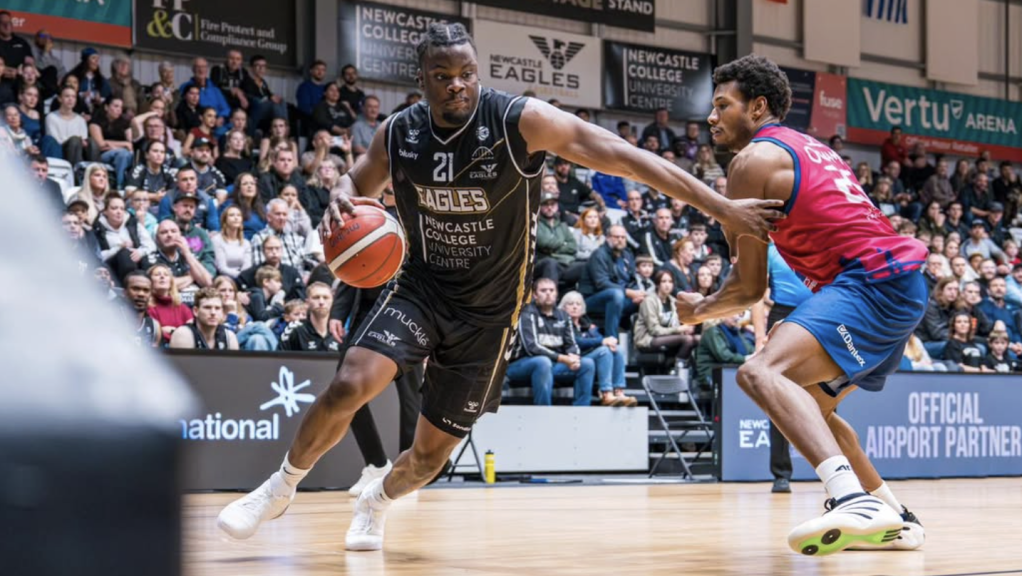
Small-ball isn’t new. For nearly a decade it has shaped modern basketball — faster line-ups that trade size for shooting, spread the floor, and switch defensively.
Newcastle have taken it in a distinctive direction. They often play without a true big, trusting mobility and strength over size in the frontcourt. Their version is about pressure — defending on the front foot, attacking with force, and turning every possession into a physical contest.
Instead of comparing teams by average height, we can look at how their heights vary across the roster. The smaller the standard deviation, the closer a team’s players are in height.
| Team | Height Standard Deviation | Average Height (cm) |
|---|---|---|
| Newcastle Eagles | 5.28 | 196.0 |
| London Lions | 6.41 | 198.0 |
| Bristol Flyers | 7.39 | 196.6 |
| Sheffield Sharks | 7.59 | 195.5 |
| Manchester Basketball | 7.96 | 195.9 |
| Surrey 89ers | 8.14 | 197.8 |
| Leicester Riders | 8.78 | 197.4 |
| Cheshire Phoenix | 8.85 | 197.8 |
| Caledonia Gladiators | 10.52 | 195.4 |
*Height calculations are weighted by minutes played, so key rotation players have a greater influence on the number.
Newcastle have the most uniform line-ups in the league — whichever five they put on the floor, the shape stays the same. The difference between their tallest and shortest rotation players is only a few centimetres.
A low standard deviation doesn’t just mean players look alike — it reveals intent. Newcastle have built a roster where overlap is the point, and the same logic carries through every number that defines them.
Making Every Possession Personal
When every player looks and moves the same, you can switch every screen and keep constant pressure on the ball.
| Team | Opp AST% | Opp TOV% |
|---|---|---|
| London Lions | 50.3% | 23.6% |
| Newcastle Eagles | 54.4% | 21.5% |
| Manchester Basketball | 56.9% | 21.7% |
| Leicester Riders | 57.9% | 17.5% |
| Cheshire Phoenix | 60.7% | 18.2% |
| Bristol Flyers | 61.5% | 19.1% |
| Caledonia Gladiators | 62.4% | 14.9% |
| Sheffield Sharks | 62.4% | 17.1% |
| Surrey 89ers | 66.5% | 17.4% |
Newcastle rank second in opponent assist rate — a sign of how effectively they take teams out of rhythm until possessions that begin with movement end in isolation. They also force turnovers on 21.5 per cent of opponent possessions, bettered only by London and Manchester. That combination — disrupted passing and constant pressure — defines how Newcastle defend.
But the same defence that squeezes the perimeter leaves space inside. Opponents score 41.4 points in the paint per game, behind only Caledonia — the cost of playing without a true rim protector.
When Defence Becomes Offence
When Newcastle get stops, they run. They rank second in fast-break scoring and play at one of the fastest tempos in the SLB. The same players who pressure defensively turn instantly into transition threats.
| Team | Fast Break PTS Per Game |
|---|---|
| Cheshire Phoenix | 14.3 |
| Newcastle Eagles | 13.9 |
| Bristol Flyers | 13.7 |
| Leicester Riders | 12.3 |
| London Lions | 11.4 |
| Caledonia Gladiators | 11.0 |
| Surrey 89ers | 10.8 |
| Manchester Basketball | 9.3 |
| Sheffield Sharks | 8.2 |
With no designated rebounder or outlet passer, anyone can start the break. Transition is the purest expression of their identity — a team that doesn’t depend on a point guard, flowing from defence to attack without structure.
When the Game Slows Down
But when the fast break is stopped, everything slows — and the limits of the same philosophy appear. The logic that drives their defence — turning every possession into a one-on-one battle — shapes their offence too. They switch on one end and isolate on the other, hunting mismatches more than they work through sets.
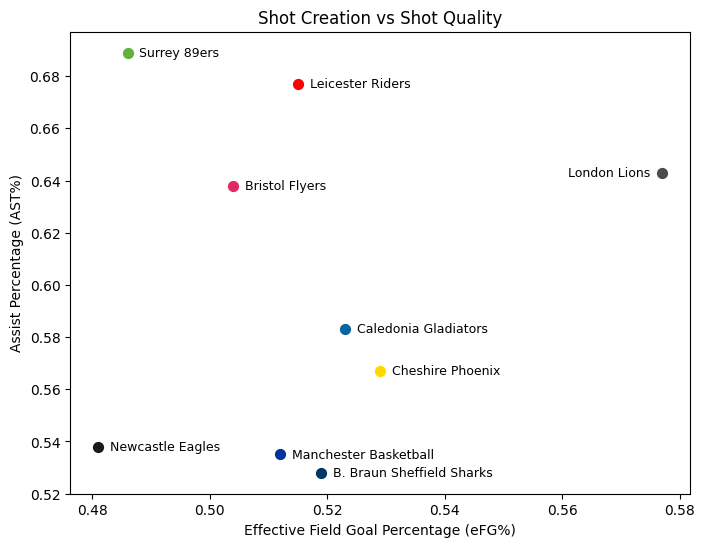
Newcastle sit in the bottom-left corner — among the lowest teams in assist rate (53.8%) and last in effective field-goal percentage (48.1%) — a reflection of how difficult their offence makes scoring.
They rely on drives and contact more than movement, reflected in a league-high free-throw rate of 36.9 per cent. Every possession becomes a contest of strength — and when defences hold their ground, it can quickly turn static.
What’s missing is spacing. Newcastle attempt just 19.7 threes per game and make only 29.7 per cent, the lowest in the league on both counts. Without perimeter threats, their physical style has to create every advantage the hard way — and when the whistles stop coming, so do the points.
Basketball, Their Way
Newcastle’s identity runs through every possession. The same principles that make them disruptive defensively shape a mismatch-hunting offence too — a system that makes complete sense, even when it stops working.
For all that identity, the results sit close to the middle. Newcastle’s net rating of –3.5 is enough for sixth in the league — a little better defensively (4th), a little worse offensively (8th). Their style is distinctive enough to define them, but not yet efficient enough to separate them.
Plenty of teams talk about having an identity. Newcastle actually play like it’s non-negotiable. It isn’t the most efficient way to win, but it’s one of the clearest expressions of what they believe basketball should look like — and that, in itself, makes them worth watching.
