

Few teams in the SLB have shifted more in the opening weeks than Newcastle. Line-ups, roles and rotations have changed almost game by game. Through eight fixtures they have already started seven different line-ups — a team still working out what it has.

London have matched that total, but their rotation reflects EuroCup demands and a deeper squad built for it. Newcastle’s changes point to something different, how the team was built and how it has been adjusted since.
What They Built, What They Became
In the SLB Show’s season preview, when the roster graphic flashed up, Grant Young didn’t hesitate. “It’s a very big-heavy squad.” Newcastle built their summer around size — multiple forwards, multiple centres, the kind of group you expect to anchor a rotation built on strength.
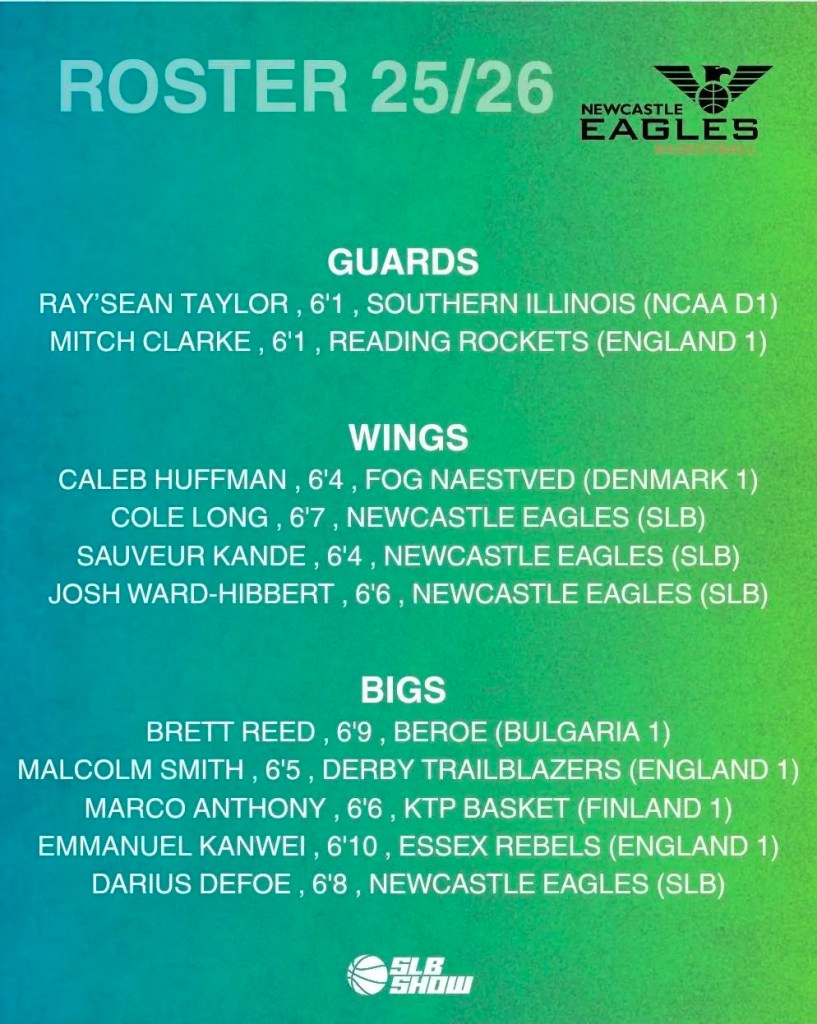
Instead they have leaned into a small-ball identity, built around speed and switching. The result is a frontcourt carried largely by forwards, with the remaining minutes for true centres spread thinly across a crowded group.
| Player | Minutes Played |
|---|---|
| Maceo Jack | 258.3 |
| Cole Long | 257.3 |
| Ray’sean Taylor | 235.5 |
| Marco Anthony | 235.0 |
| Mitch Clarke | 183.7 |
| Malcolm Smith | 83.6 |
| Brett Reed | 82.6 |
| Deion Hammond | 70.9 |
| Emmanuel Kanwei | 69.6 |
| Gus Okafor | 57.3 |
| Josh Ward-Hibbert | 45.8 |
| Sauveur Kande | 30.5 |
| Darius Defoe | 15.0 |
Of the bigs highlighted in the preview, only 6’6 Marco Anthony has become a core rotation piece. Brett Reed is no longer in the squad, while the remaining centre minutes have been split between Cole Long, Malcolm Smith, Emmanuel Kanwei, Gus Okafor and Darius Defoe — a rotation stretched across too many players for the role to ever settle.
A Turnover of Players
Newcastle have been one of the quickest teams in the league to make personnel changes this season. Caleb Huffman was cut before the season began, replaced by Maceo Jack. Brett Reed lasted four games before being released for Deion Hammond.
Even when Gus Okafor was signed as a pure addition, the club’s announcement noted it would “continue to monitor its playing options” — routine language that hinted at the balance of power. The organisation can pivot quickly while players have little certainty.
We’ve Seen This Before
None of this is entirely new. Last season Mike Okauru became Newcastle’s centrepiece — one of the most impactful players in the league. When he wasn’t on the floor, Newcastle felt it. But he didn’t begin the season in the starting five.
On the Brits Don’t Jump podcast, host Nathan Doyle asked Okauru whether coach Marc Steutel built the system around him straight away. Okauru’s answer was a clear no.
“I don’t know if you guys remember, but to start the season I was coming off the bench for the first eight or nine games.”
He wasn’t offering it as criticism. It was simply how things unfolded. He grew into the role because of what happened in real games, not because it was mapped out in advance.
Finding Themselves As They Go
The churn is the constant. Newcastle rarely start a season settled. Roles shift, line-ups change, and combinations are tested at speed. This year’s version stems from a frontcourt-heavy recruitment that hasn’t matched their preferred style, early injuries and swift roster decisions.
Identity forms on the floor. Newcastle don’t settle their rotation early because settling early isn’t who they are. The search is already in motion, and the question is simply how long it takes.
