
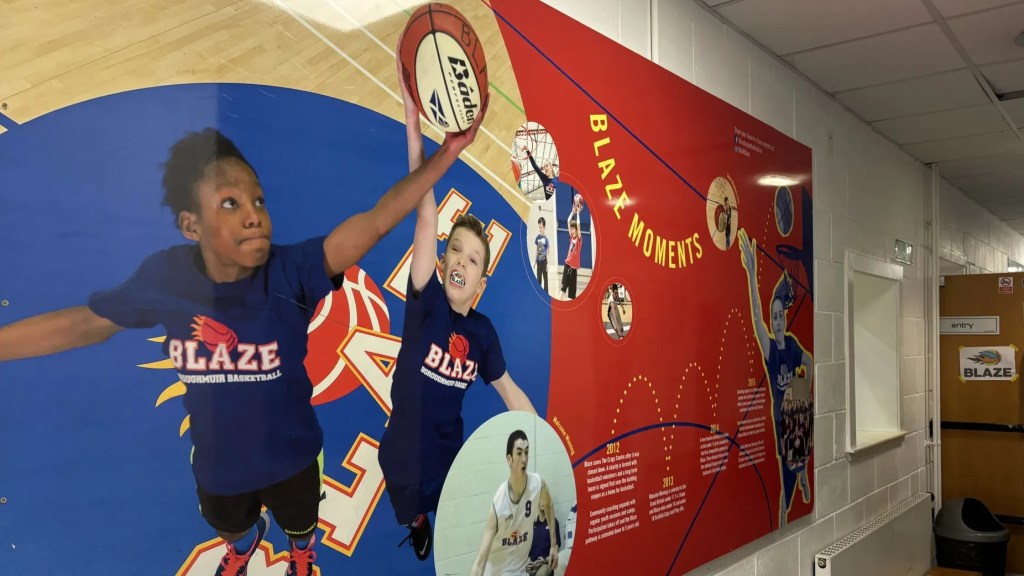
Blaze Basketball stand out because of what sits underneath the teams you see on the court. Access to the Crags Centre, coaches who’ve come through the club and a pathway that stays steady from the youngest squads to the senior teams make development feel less like an ambition and more like the way things work.
What Access Makes Possible
The rise of Kwame Mireku shows what that environment can produce. He joined Blaze at under-18 level having never played basketball before. Three and a half years later, he has committed to play for Regina University in Canada.
The Crags Centre in Edinburgh is central to that story. It is operated by We Play Together, the charity that also operates Blaze Basketball Club. That setup means Blaze always have the court time they need — a rarity in Britain, where most clubs rent short windows of court time squeezed between other sports.
The club lean into that advantage through their keyholder policy. A keyholder is someone trained to unlock the building and use the court independently. At Blaze, coaches and senior players can become keyholders after completing the required process. Junior players cannot hold keys, but they can train with adults who do.
This shapes development. Players can spend more time on the court, more often, and with more consistency than is typical elsewhere. Progress is built in the gaps between organised sessions — the hours spent repeating movements, shooting alone or joining older players. As a junior, Kwame trained with keyholders and used the practice space to work on his game long before receiving his own key. He took advantage of the access on offer — a core part of how Blaze develop players.
Coaching Grown From Within
The environment is reinforced by the people who shape it. At Blaze, coaching is treated as another layer of development, and much of the club’s coherence comes from head coach Alan Keane’s approach. He frames the philosophy clearly:
Coaches helping coaches is the greatest enabler of coach and player development.
Two coaching groups underpin the system: assistant coaches employed by the club, and apprentice coaches who make up the coach development scheme. Both groups are growing year on year.
| Coach Category | 2024/25 | 2025/26 |
|---|---|---|
| Assistant | 17 | 19 |
| Apprentice | 15 | 27 |
That coaching pathway grows from within. Seven of this season’s assistants were apprentices last year, and every apprentice coach is already a Blaze member.
That progression gives the club depth you rarely see. Many programmes rely on a handful of volunteers stretched across age groups. Blaze have built a coaching structure with clear standards and continuity.
A Club Built for Everyone
Blaze run 24 squads from under-10s through to senior men’s and women’s, competing across national and regional leagues. That scale lets the club place players where they’ll develop rather than where there happens to be space.
It also creates continuity. Each stage feels connected to the last, with standards that don’t reset as players step up and a structure that prepares them for what comes next rather than dropping them into something unfamiliar. For Blaze, that breadth gives players a sense of belonging to something larger than their individual team.
How the Pieces Fit
Put the pieces side by side and the pattern becomes hard to miss. Reliable access to the Crags, a coaching pathway built from within and a club structure that stays steady from juniors to seniors give Blaze an advantage few British clubs can match.
From the outside, it might look like development just happens here. In reality it’s the result of decisions repeated over years. When those foundations hold, improvement feels inevitable.
