
Coaching philosophies are easy to articulate in isolation. They are harder to sustain when the environment changes.
For teams competing across multiple leagues, the real test is not whether a coach has a philosophy, but how that philosophy adapts under pressure. Does it scale when the opposition improves? Does it hold when margins shrink?
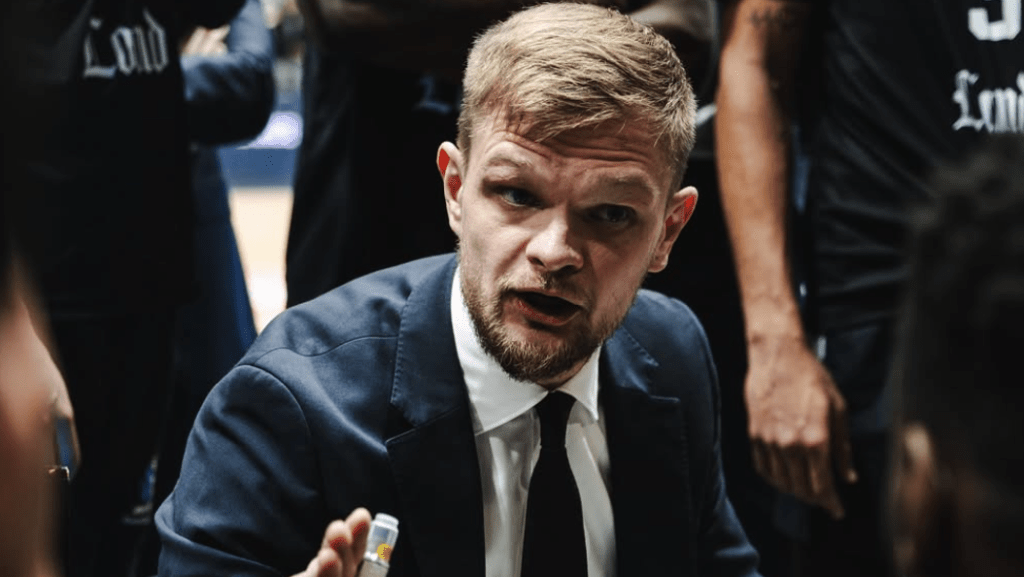
For the London Lions, that contrast is explicit. Asked on Baseline about how he approaches line-ups across competitions, head coach Tautvydas Sabonis put it plainly:
In SLB, we’re the top dog. In EuroCup, we’re not top dog. So we’ve got to find the right match-up that will work, find the right balance off the bench.
The roster is the same. The coach is the same. What changes is the environment — and the decisions it forces.
Depth in Context
Depth is a competitive advantage in the SLB. In EuroCup, it is a baseline requirement.
| Competition | Bench Minutes % | Rank |
|---|---|---|
| SLB | 46.2% | 1st of 9 |
| EuroCup | 46.0% | 12th of 20 |
In the SLB, London are deeper than every other team. Nearly half of their minutes come from non-starters, the highest share in the league. That depth allows them to rotate freely, spread responsibility, and manage the season without leaning heavily on a small core.
In EuroCup, London’s bench minutes sit at almost exactly the same level. But in that environment, depth is not a differentiator. The same behaviour places them firmly in the middle of the competition. What separates London domestically becomes ordinary in Europe.
Starting Is Not Status
London treat starting line-ups very differently across the two competitions.
| Competition | % of Games with a Unique Starting Line-up | Rank |
|---|---|---|
| SLB | 86.7% | 1st of 9 |
| Eurocup | 66.7% | =11th of 20 |
In the SLB, London change their starting five in almost every game. Over 86 percent of domestic fixtures have featured a unique line-up, the highest rate in the league. Starting is treated as a tactical decision rather than a declaration of hierarchy, with combinations adjusted game to game rather than fixed in advance.
That approach aligns with how Sabonis describes his thinking.
Everybody has an opportunity to start. I don’t believe in starting.
Roles are not fixed at tip-off, and responsibility is not assigned by who starts the game.
When the competition changes, that flexibility tightens. In EuroCup, London still rotate their starting group, but far less aggressively. The pool of players remains similar, but the combinations stabilise as margins narrow.
When Minutes Tighten
The clearest expression of London’s shifting rotation logic comes at the player level.
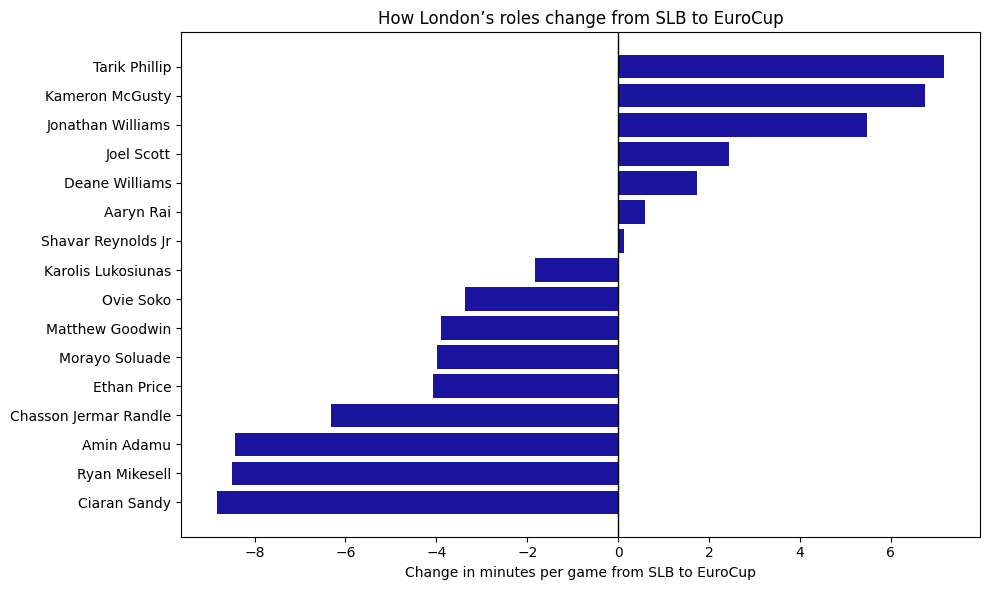
In the SLB, responsibility is deliberately flattened. No player averages more than 24 minutes per game. The top of the rotation is capped.
In EuroCup, that distribution changes by design. A small core absorbs significantly more load. Phillip, McGusty, and Jonathan Williams all gain minutes. These are the players London rely on when possessions matter more and mistakes are punished.
That concentration sits comfortably with how Sabonis has described his background.
In Lithuania, the starting doesn’t matter. It’s who finishes the game.
In Europe, some of London’s most important minutes come from players who do not always open games. The starting line-up remains flexible, but responsibility hardens as the game settles.
Philosophy Under Constraint
Taken together, these patterns show a consistent philosophy — a belief that roles matter more than labels, and that responsibility should emerge from context rather than status.
London do not abandon their approach in Europe. Depth, flexibility, and opportunity remain, but the environment dictates how far each can be pushed. The SLB rewards experimentation and load-sharing. EuroCup demands concentrated responsibility.
The same roster behaves differently not because the thinking changes, but because the leagues do.
