
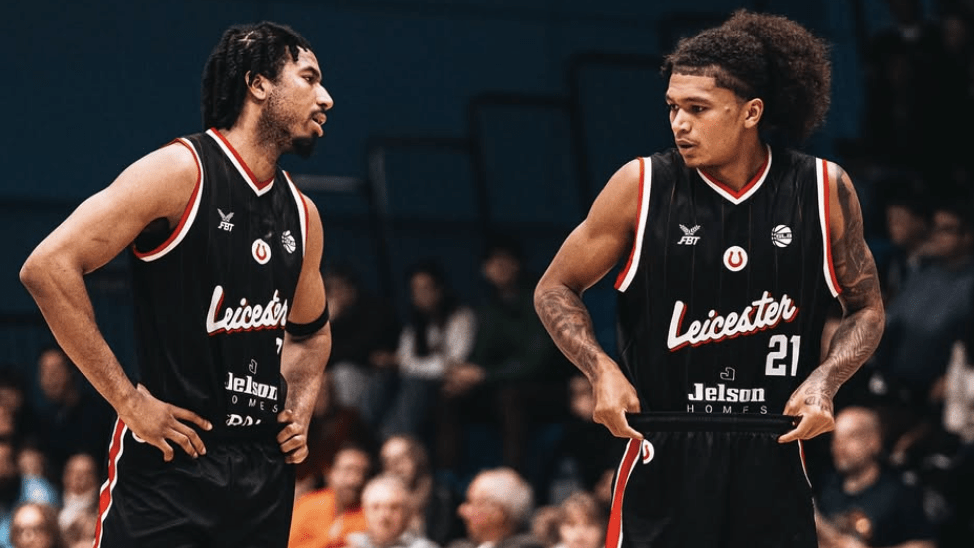
Don Carey Jr leads the league in assists per game. RayQuan Battle leads it in points per game.
That alone would make Leicester’s backcourt stand out. What elevates it is how cleanly those roles are defined – and how little they compete with one another. Carey organises and shapes possessions. Battle finishes them. Together, they give Leicester a level of backcourt clarity few teams ever find.
Seeing More Angles
Carey’s place at the top of the assist table is definitive:
| Player | AST Per Game |
|---|---|
| Don Carey Jr | 7.0 |
| Ronald Polite III | 6.2 |
| Jordan Johnson | 5.4 |
| Joseph Anderson | 5.4 |
| LaQuincy Rideau | 5.2 |
But the way Carey generates those assists is what truly separates him. Listed at just over six foot four, he is one of the tallest guards in the league, and that size changes the geometry of the floor. Against smaller defenders, he does not need to create separation simply to see the play develop. He can look over the defence, not around it.
From those positions, Carey finds cutters early, hits shooters as help commits, or feeds a rolling big before the defence has fully collapsed. His assists come from initiating offence in areas that already force defensive decisions.
That passing works because Carey is not a pass-only organiser. Eighth in the league in points per game, he can punish mismatches in multiple ways – finishing through contact, pulling up over smaller guards, or exploiting switches. That scoring range turns his vision into a constant threat rather than something defences can safely sit on.
Pressure That Never Drops
If Carey is tasked with control, Battle is tasked with damage. And it shows up immediately in the scoring table:
| Player | PTS Per Game | eFG% |
|---|---|---|
| RaeQuan Battle | 21.1 | 59.2% |
| Pat Robinson | 19.1 | 60.0% |
| Kevin Allen | 18.6 | 58.1% |
| Kino Lily Jr | 17.0 | 58.3% |
| Joel Scott | 16.7 | 65.0% |
*Only players who have played more than five games are included
Battle is not just scoring more than anyone else – he is doing it efficiently. Give him a fraction of space and he will shoot. He leads the league in three-point attempts per game, converting them at 42.4 percent, which forces defences to stay attached at all times.
That attention creates secondary pressure. Close out too aggressively and Battle can get downhill. Show help early and his shotmaking allows him to pull up in the midrange. There is no comfortable coverage and no possession where the defence can relax once the ball finds him.
Leicester do not ask Battle to be a playmaker. His reads are intentionally simple – catch, attack, score – and that clarity sharpens both his efficiency and the flow of the offence around him.
No Easy Targets
Carey and Battle are both listed around six foot four, size that matters defensively at the smallest positions on the floor. It closes passing lanes earlier, shortens contests, and removes easy mismatches for opponents to hunt. Leicester are not carrying defensive trade-offs to unlock their offence.
That physical profile reinforces the structure of the backcourt rather than complicating it. Carey controls tempo and structure. Battle supplies urgency and scoring gravity.
The League’s Best Backcourt
Carey and Battle’s skill sets amplify one another rather than overlapping unnecessarily. Carey’s scoring threat creates space for Battle. Battle’s scoring gravity simplifies Carey’s reads. Both guards are big enough defensively to avoid being targeted, which raises the floor of the entire unit.
With focuses clearly divided – Carey tasked with more organisation, Battle with more finishing – each player becomes more effective in his role.
When the league’s assist leader and its leading scorer share a backcourt, the conclusion follows naturally. This is the standard the rest of the league is now chasing.
