
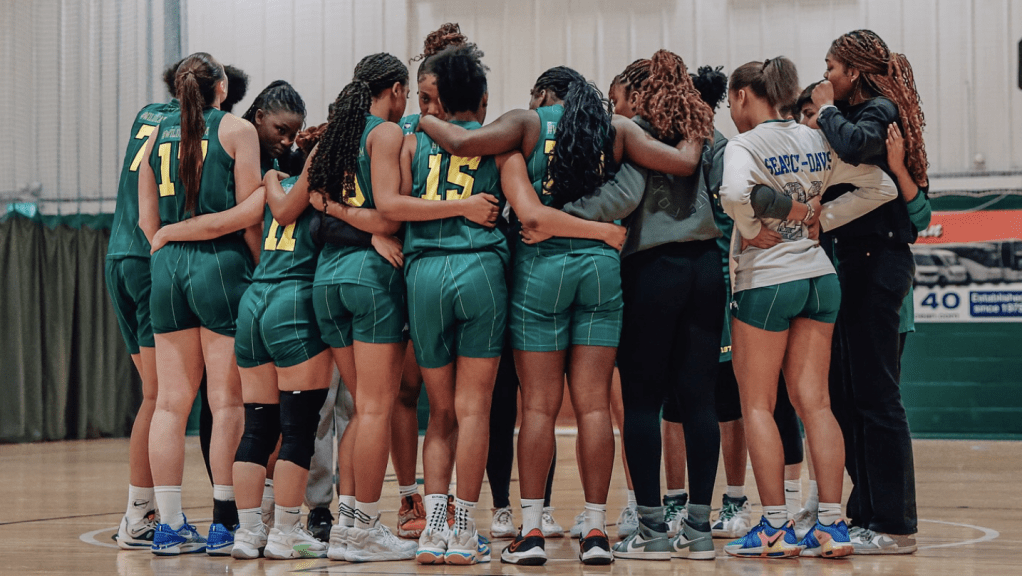
The academy players were running a practice drill for their base man-to-man offence on the sprung wooden court of the Wildcats Arena. The rule was simple: every possession had to start with a wing entry pass.
One of the players kept trying to get free on the wing. Her defender denied her every time. Possession after possession came and went without her touching the ball. The frustration was obvious.
WEABL head coach and academy director Siobhán Prior stopped the drill to talk to her.
These are the moments you came here for. This is the point of growth. You have a choice to lean into it and grow or shy away and shrink. I know you can lean in. Be brave.
The drill restarted. Her defender did not relent. Getting free was still a struggle, but she did not give up. Frustration gave way to resolve.
When practice ended, she stayed behind and asked Prior for a hug. It was happily given.
Years in the Making
Nottingham Wildcats were founded in 1976 and became a major presence in women’s basketball by the 1980s. But as the club expanded, access to court space became the limiting factor — not just practically, but financially.
Court hire shaped everything. It dictated how often teams could train, how reliably sessions could run, and how far ahead anything could be planned. It also absorbed a significant share of the club’s resources, turning space into a recurring cost.
That changed in 2001 with the opening of the Nottingham Wildcats Arena. It was the first purpose-built basketball venue in the UK owned and operated by a basketball club. More importantly, it shifted space from an ongoing expense to an asset the club could control.
The arena is a home — a place where training happens without negotiation, where routines can be repeated, and where financial pressures no longer dictate daily decisions. Players and families move through the same space year after year. Fifty years of the club’s history run through it, and every player who passes through becomes part of that legacy.
Where You Stand
Alongside its wider junior programme across Nottingham, the Wildcats operate an academy with clear stages of progression. Moving into the higher levels is invitation-only. As players advance, places are earned, expectations rise, and roles sharpen.
The academy pathway is built around level of play. Players are placed into one of two programmes: Develop and Perform, with Perform sitting above Develop in standard and expectation.
Each programme has a main competition:
| Academy Programme | Competition |
|---|---|
| Perform (Women) | WEABL |
| Develop (Women) | Association of Colleges (AoC) |
| Perform (Men) | CBL |
| Develop (Men) | Local CVL (Central Venue League) |
Players can move between teams as they develop. Coaches place them at the level that fits.
That only works if roles stay clear. League rules mean academy teams aren’t fully interchangeable, so players are assigned a tier for each team that shows exactly where they sit on the pathway. Each tier comes with its own expectations.
| Player Tier | Expectations |
|---|---|
| Roster Player | – Play all games when selected – Attend all team practices – Attend all relevant individual sessions |
| Squad Player | – Attend all team practices – Attend all relevant individual sessions |
| Practice Player | – Attend team practices by invite |
A player might play AoC minutes as a roster player while training in WEABL sessions as a practice player — trusted with responsibility in one environment, stretched by the demands of another.
Standards are high, but they are not hidden. Players are challenged, but they are not left guessing. As academy director Siobhán Prior puts it:
Creating a competitive environment is so much more complex than just letting everyone go at it.
The Shape of a Week
For women in the Perform programme, the week follows a clear rhythm that shifts with the fixture list.
Mondays begin with study hall. Before anyone steps on court, players sit down together to complete academic work. If work is overdue, they don’t take part in basketball activity until it’s finished — staying in study hall as practice begins, sometimes completing it courtside before being readmitted.
The arena sits next door to the school the players attend. With no commute between classroom and court, education standards can be enforced in real time. After study hall, the day moves into strength work, then onto the court.
Tuesday is team practice. After that, the week is shaped by whether there’s a midweek fixture.
In game weeks, Wednesday is competition day. The performance environment becomes public, with habits tested under pressure rather than in drills. Strength work follows after home games. Thursday becomes a lighter day, with meditation and individual skill work.
In non-game weeks, Wednesday becomes another full team practice followed by strength work. Thursday becomes a development day: strength work, then a shooting session focused on mechanics and shots from Wildcats offensive actions.
Friday brings the group back together. Team practice returns, followed by a longer strength session to close the week.
The work is demanding, but support is built in. A wellbeing officer is available every Thursday, and player load is monitored through an app to track fatigue and stress.
It’s a tough environment, and it isn’t for everyone — but the expectations are clear, and the players know what they’re signing up for.
Who Holds Legacy
Outside the competitive season, pickup becomes a central part of the programme. The off-season handbook devotes a full section to it — not just when it happens, but how it’s meant to work.
The court is shared by a deliberately broad group: current academy players, club juniors from under-14 through under-18, academy alumni home from the UK or US college system, and senior players or external invites passing through.
Those returning from the US bring pace, physicality, and attention to detail with them, and the level rises immediately. Younger players aren’t briefed on how it’s meant to feel. They learn it by being in it.
Teams are organised on the floor. Fouls are called by those involved. Disagreements are settled without intervention. Coaches are present, but they stay out of the way unless safety requires it.
What holds it together is trust. Players compete hard, knowing intensity won’t threaten their place. Structure recedes, but standards remain — carried by the people who learned them here and return with them intact.
