
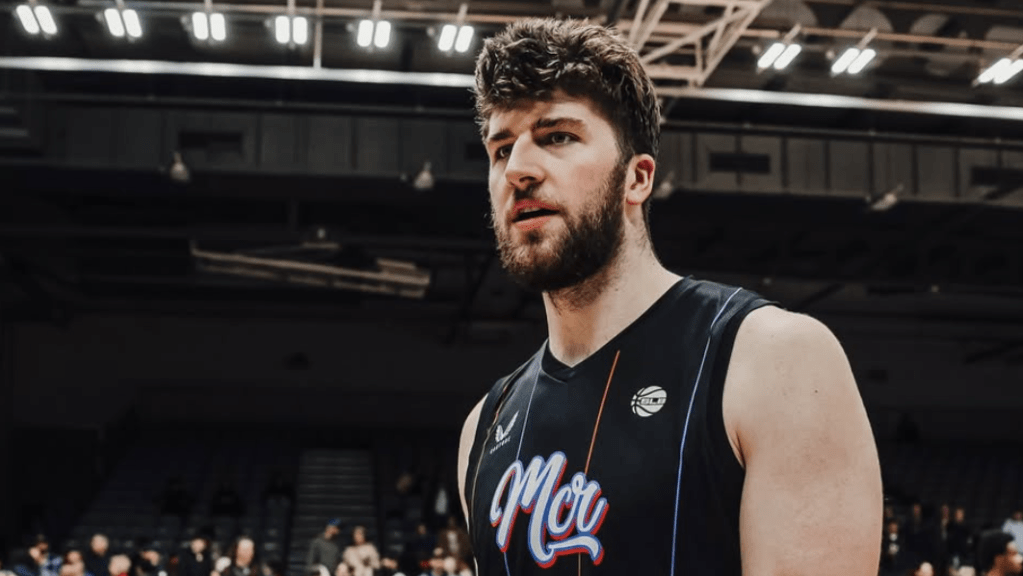
Manchester’s numbers with Matt Nicholson on the floor tell a story that is both encouraging and frustrating. When he plays, opponents’ shot selection shifts away from the rim and towards less efficient areas of the floor.
And yet the overall defensive impact remains modest. The shape of possessions changes, but the scoreboard barely does.
This post uses Prophe(s)y Scout possession-level data kindly shared with Court Vision, showing how often opponents take certain shots, and how well they make them, when a player is on the court versus off.
Protecting the Paint
The table below is league-wide, showing how much less often opponents shoot at the rim, and how their rim finishing changes, when each player is on the court versus off.
| Player | Opp % of Rim Shots Difference | Opp Rim FG% Difference |
|---|---|---|
| Darnell Brodie | -9.5 | +1.4% |
| Matt Nicholson | -8.8 | -1.0% |
| Marco Anthony | -6.7 | +0.8% |
| Tyrin Lawrence | -6.5 | +2.1% |
| Don Carey Jr | -6.2 | +3.6% |
* Only includes players who have played more than 200 minutes
Nicholson is the only player in this top group pairing fewer opponent rim attempts with a lower rim percentage. Brodie suppresses rim volume more, but opponents finish better; Anthony, Lawrence and Carey Jr also reduce rim volume, but rim percentage rises in their minutes.
Nicholson’s combination is the clearest “less rim, slightly worse rim” profile on the list: for every 100 shots opponents take, 8.8 fewer are at the rim in Nicholson’s minutes, and they shoot 1.0% worse when they get there.
Allowing Midrange Shots
Using the same league-wide on/off splits, the table shows who shifts opponents towards mid-range attempts and how efficient those shots are.
| Player | Opp % of Midrange Shots Difference | Opp Midrange FG% Difference |
|---|---|---|
| Matt Nicholson | +9.4 | -0.8% |
| Darnell Brodie | +7.1 | +4.1% |
| Michael Diggins | +6.9 | -3.0% |
| Andrew Lawrence | +5.6 | +0.3% |
| Tyrin Lawrence | +5.2 | +4.7% |
* Only includes players who have played more than 200 minutes
Nicholson is comfortably top of the list for increasing opponent mid-range attempts. Opponents take far more mid-range shots in his minutes than against anyone else in the league, and their accuracy on those shots dips slightly. Combined with the rim numbers, it suggests Nicholson is reshaping where opponents shoot from.
Leaking From the Three
You would expect those shifts in opponent shot profile to show up as a clear defensive jump. Instead, Manchester are essentially defending just as well with him as without him. Their defence is 0.3 points worse per 100 possessions in Nicholson’s minutes, basically no change.
The clearest reason the overall impact stays flat is opponent three-point shooting. A lot of the value Nicholson is helping create inside is being cancelled out by opponent shooting from the arc in those same minutes. League-wide, he also ranks near the top for increases in opponent three-point percentage in these on/off splits.
| Player | Opp 3P% Difference |
|---|---|
| Patrick Smith Jr | +10.0% |
| Jaxon Brenchley | +6.9% |
| Skyler White | +6.8% |
| Cole Long | +6.2% |
| Tarik Phillip | +5.8% |
| Matt Nicholson | +5.2% |
* Only includes players who have played more than 200 minutes
Nicholson showing up here does not mean he is the cause. Opponent 3P% is volatile, and on/off stats describe what happens when a group shares the floor rather than pinning responsibility on one defender.
Patrick Smith Jr sitting top of the list points towards a wider perimeter issue in those minutes, but it is not proof on its own. Whether this is hot shooting that drops back towards normal or a real issue in how Manchester are defending the arc, the effect is the same: strong three-point results for opponents are flattening Nicholson’s overall defensive impact.
Real Defensive Influence
Nicholson’s profile is something worth building a defence around. When he is on the floor, opponents are pulled away from the rim and pushed towards mid-range shots. Steering attacks away from the highest-value looks is the kind of defensive footprint that usually matters.
But until the three-point picture improves, that footprint will keep showing up clearly in the shot map, while the headline impact stays basically flat.
