

Bristol brought back less of last season’s rotation than almost anyone else in the league. Early on, it looked like they had changed well. The ball moved, the scoring was shared, and the defence was tough.
But once the league caught up, they struggled to change again.
Early Promise
On 21 November, the Lions arrived at the SGS College Arena unbeaten, with eight wins from eight and by far the best net rating in the league. Bristol beat them by playing a slow, uncomfortable game of basketball.
The Flyers scored just 68 points, but that did not matter because they held London to 54. The Lions shot 3-for-29 from three, Joe Anderson gave Bristol enough calm ball handling to cope with London’s pressure, and the defence did the rest.
Up to that game, London were still the strongest team in the league by the numbers. Bristol were next.
| Team | Net Rating |
|---|---|
| London Lions | +22.4 |
| Bristol Flyers | +8.4 |
| Sheffield Sharks | +3.5 |
| Cheshire Phoenix | +1.5 |
| Manchester Basketball | -3.8 |
| Newcastle Eagles | -4.0 |
| Surrey 89ers | -5.7 |
| Leicester Riders | -9.6 |
| Caledonia Gladiators | -11.0 |
The London win was not an isolated upset. Bristol had built one of the strongest early profiles in the league.
When the League Caught Up
The version of Bristol that beat London did not disappear immediately, but became less effective as the season went on.
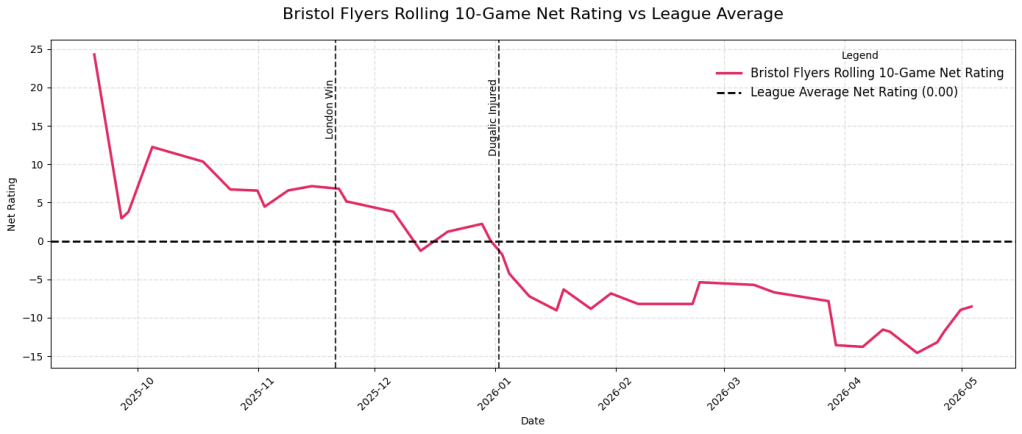
After the London win, their net rating gradually moved down, fell below league average around the time of Miloš Dugalić’s injury, and never truly recovered.
Dugalić was not the player everything ran through. But his length and physical presence helped the team’s defensive shape. When he went down, Bristol lost some of the size and versatility that had helped make the early version work.
Before Dugalić’s injury, the Flyers had a defensive rating of 107.6, second best in the league behind only London. After it, that number fell to 116.6, fifth in the league.
For most of the season, Bristol had been built on defensive structure and enough creation from Joe Anderson to hold the offence together.
Forced to Change
Joe Anderson was out through a late-season injury, and Bristol had to change.
In the play-offs, Cam Holden started as the de facto point guard. Bristol went bigger, with length across every position, and tried to turn defence into transition in a two-game series against Manchester.
Two close games ended in an eight-point aggregate defeat. Bristol had found a new look, but too late for it to settle.
The Reinvention Came Too Late
Off the court, Bristol’s larger reinvention is finally moving closer, with work underway on their long-planned arena.
On the court, Bristol changed over the summer, and for a while it worked. When the league caught up, they could not change again quickly enough.
Another version appeared in the play-offs, but it arrived too late to change the season.
